Reid Davenport’s I Didn’t See You There takes the viewer through a day in his life as a disabled man, portraying his experience of living with a disability. Rather than framing his daily challenges as obstacles to be overcome, Davenport’s approach is both simple and profound—he simply positions himself as a filmmaker, filming his life. The film’s unique approach, which involves attaching the camera to his wheelchair, results in a point-of-view documentary that immerses the audience in his perspective, quite literally allowing them to see the world through his eyes. This method isn’t just a stylistic choice, but a direct commentary on the way disability is typically portrayed in media. Too often, disability is either framed as an obstacle to be overcome or a tragedy that evokes pity. In contrast, Davenport offers no such framing—he simply shows us his life as it is, asking us to look beyond our conventional assumptions and engage with disability on a deeper level.
One of the most striking aspects of the film is Davenport’s decision to focus on the constant motion that he experiences in his daily life. The camera, attached to his wheelchair, captures his environment from his level, which results in a moving, shifting view that can feel disorienting to the viewer. The sense of perpetual motion is reminiscent of the feeling one might get from watching a scene unfold from a moving train—everything around you is in motion, and there’s very little control over the pace or direction. This is a feeling that Davenport experiences daily, but one that is largely invisible to those who don’t live with a disability. Initially, the constant shifting of the camera was disorienting for me as a viewer—I found myself wanting to look away or regain my balance. But upon reflection, I realized that this discomfort was exactly the point. Davenport’s aim is not just to show us his life, but to confront us with the physical discomforts of disability—both the subtle and the more obvious.
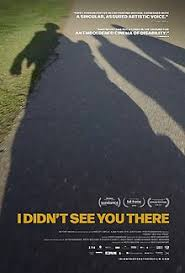
This discomfort, I believe, is part of what Davenport is trying to provoke. Through his film, he forces us to confront the uncomfortable realities of living with a disability. From the more ‘minor’ inconvenience of being in constant motion, to the more overt and tangible forms of discrimination and exclusion that he faces on a daily basis, Davenport uses the viewer’s discomfort to foster a deeper reflection on the accessibility of our world. What’s striking is that this is not a film that asks for sympathy, nor does it offer easy resolutions like films I’ve watched about disability often do. Instead, it prompts viewers to acknowledge how inaccessible much of the world is to those with disabilities, and challenges us to think critically about the structures that perpetuate this system.
In this way, I Didn’t See You There is not just a personal documentary, but a social commentary. By inviting us into his world—one that many of us may never truly understand—Davenport makes us examine our own assumptions about disability and accessibility. It compels us to rethink how we engage with those whose experiences are different from our own, and to draw our own conclusions about what it would mean to create a more inclusive and accessible society.
References:
Wilson, Keith. I Didn’t See You There. Directed by Reid Davenport, : [Good Docs], 2023.
Leave a Reply